From a line in a hall to a mill building
Several floors
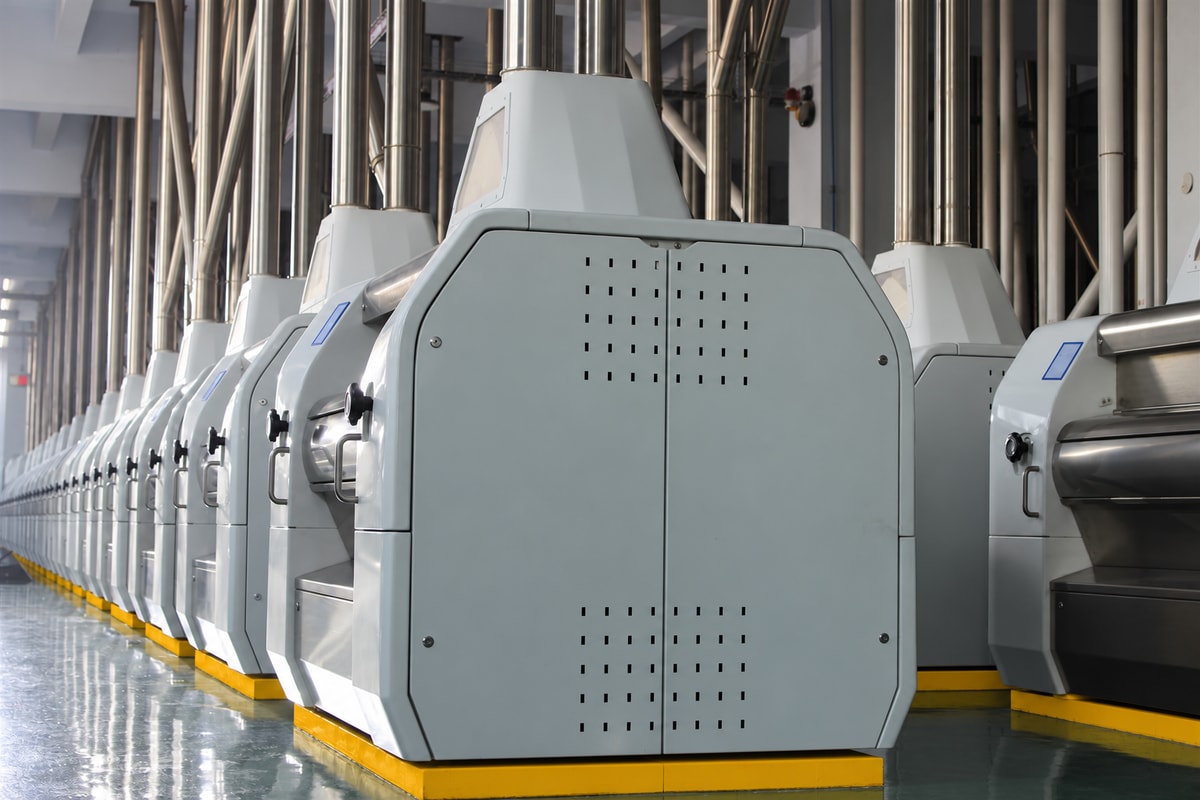
Roller mills, plansifters and cleaning stand on separate floors, in a steel structure or a concrete building, so stock flows down by gravity and is lifted by air.
Storage and blending
Raw wheat silos and blending let you mix wheat lots to hold flour quality steady. Tempering usually has two stages with tempering bins between them.
Bulk bins and several products
Flour goes to bulk bins before packing, so the mill can make more than one flour and pack them to order.
The figures we check before anything else
Per 100 kg of wheat
Set by your wheat and extraction target. Our 60–120 TPD references run from about 6.7 to 8.4 mm per 100 kg a day.
Per tonne of wheat
Enough sieve area for clean, low-ash flour. The 82 TPD reference has about 0.62 m² per tonne.
For the dirtiest wheat you will buy
The cleaning section is sized for the worst wheat you expect, not the average lot.
See the 60–120 TPD configurations for the reference figures.
Six things for a first configuration
Capacity
Tonnes of wheat a day now, and the capacity you plan to reach.
Wheat
Origin, hard or soft, how much dirt and stone it carries.
Flour
Which flours you sell, target extraction and ash, bag sizes.
Site
Site plan or existing building drawing with heights.
Power
Supply voltage and frequency, and the capacity of your connection.
Timing
When you want to mill the first wheat.
One itemised offer for the whole mill
Flow sheet and layout
Cleaning, tempering, milling, sifting and packing drawn for your wheat and your flour, with the machine layout on your building or site.
Every machine with motors
Listed line by line with model, quantity and power, so each item can be compared with another offer.
Platform, spouts, pneumatics
Steel platform or supports, spouting, pneumatic lift pipes, dust filters, airlocks and pipework made to the layout.
Control panels and cables
Control cabinets for cleaning and milling, cables, and the air compressor for packing and filters.
Wear parts
Spare rolls, sieves and wear parts can be added so they ship in the same containers.
Installation and training
Engineers supervise installation and start-up and train your operators. Civil works, local labour and lifting equipment are on the buyer's side.
Questions about this size
Why is there no standard machine list for 150–250 TPD?
At this size the list depends on the building, the wheat and the flour range. A standard list would either miss machines you need or include ones you don't. We draw it for your project.
Steel structure or concrete building?
Steel structure is faster and suits sites without a building. A concrete building costs more on site but lasts longer and carries vibration better. We lay out the mill for either.
Do you design the wheat silos too?
Yes. Raw wheat storage, blending and tempering bins are part of the flow sheet.
Send capacity, country and wheat
Farivo engineering team
We reply with a flow sheet, a machine list and an itemised offer. Add a site plan or building drawing if you have one.