The pipes are where a new mill loses weeks on site
Machines arrive finished. Spouting is often left to local welders, measured on site and cut to fit. That is where flanges miss, bends wear through and the start-up date moves.
Made from the same drawings
Spouts, transitions and connection pieces are drawn from the same layout as the machines, so inlet and outlet flanges match the equipment they connect to.
Ends finished before shipping
Pipes and fittings leave with flanges or coupling lips already formed. On site they are bolted or clamped together instead of cut and welded.
Same container as the machines
Pipework is packed around the machines. You plan one shipment and one customs clearance for the whole section.
11 groups, 141 product types, 6,160 SKUs
Select diameter, connection, material and operating configuration from the tables. Wall thickness is shown where specified. Other sizes, square sections and special angles are made to drawing.
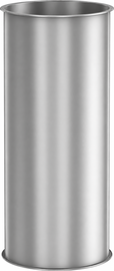 11 types · 897 SKUs
Gravity spouts and straight pipes
Welded, push-in and spigot pipes
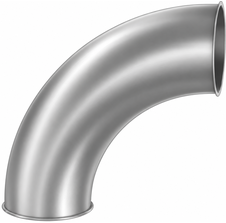 16 types · 943 SKUs
Bends and segments
5°–90°, R 1D, 2D and long radius
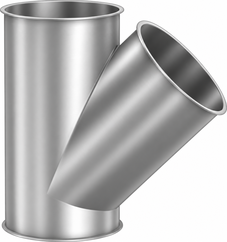 3 types · 234 SKUs
Branch pieces: T-pieces and forks
T-pieces, forks, symmetrical forks
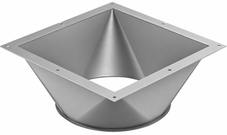 21 types · 525 SKUs
Transition pieces and machine connections
Cones, round-to-square, hoses, bagging spouts
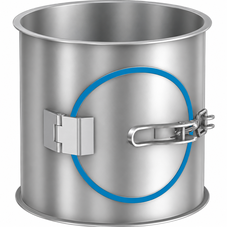 6 types · 184 SKUs
Inspection and cleaning pieces
Inspection windows, cleaning doors, clear sections
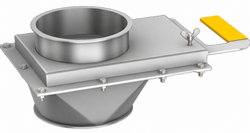 14 types · 579 SKUs
Slide gates and throttle valves
Throttle valves, slide gates, non-return valves
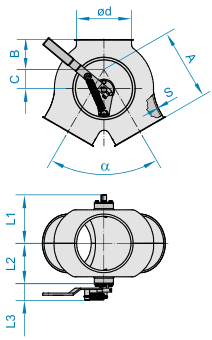 24 types · 860 SKUs
Two-way diverters
Gravity and sealed, manual or pneumatic
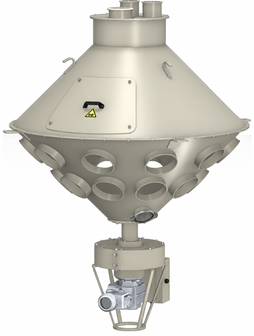 7 types · 287 SKUs
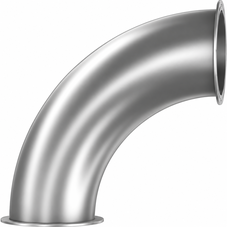
Multi-way distributors
Turn-head and swivel distributors
 24 types · 1000 SKUs
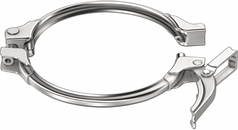
Flanged ducting and fittings
Flanged pipes, bends, branches, valves, flanges
 9 types · 323 SKUs
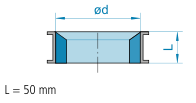
Couplings, clamps and supports
Pull-rings, seals, clamps, supports
 6 types · 328 SKUs
Wear-lined parts
Lined pipes, segments and forks
Four choices that decide how long the pipework lasts
Galvanised, coated or stainless
Galvanised steel suits most gravity spouts for grain and stock. Powder-coated steel is used where colour coding or appearance matters. Stainless steel is chosen for flour and finished product lines and for humid areas.
Thicker where stock hits
Use 1 to 1.5 mm for aspiration ducts and low-wear runs, and 2 to 3 mm for spouts carrying wheat, bran or offal, especially below elevators and at bends.
As large as the space allows
A 2D or long-radius bend changes direction more gently than a 1D bend, so it wears less and is less likely to choke. Use 1D only where the floor height leaves no room.
Flanges or pull-ring couplings
Flanges suit fixed runs and positive-pressure lines. Pull-ring couplings with seals let you open a spout in minutes for cleaning or changing a worn bend.
Line the first bend
The first bend after a fall and the outlet of a diverter take most of the impact. A lined part there usually costs less than replacing plain bends again and again.
Plan the inspection doors
Put inspection or cleaning pieces above each diverter and at long horizontal runs, so a blockage is found and cleared without stopping the whole section.
What to send us
Your layout or flow sheet
Send the building layout and process flow sheet. We list every spout, fitting and support from it, and quote the pipework with the machines.
A photo and the sizes
For a replacement or extension, send a photo of the part, its diameter, wall thickness, angle and connection type, and the quantity.
A drawing or a sample
For hoppers, square sections and odd angles, send a sketch with dimensions or a drawing. We confirm the drawing with you before cutting steel.
Questions mills ask about pipework
Can you supply only the pipework for machines we already have?
Yes. Send the machine inlet and outlet sizes or a photo of each connection, and the layout of the run. We make the connection pieces to suit.
Do you work in metric or inch sizes?
Our standard series is metric (DN). If your mill uses inch pipe or another standard, give us the outside diameter and we make to it.
Is the pipework priced per piece?
Each quotation lists every part with its size, material and quantity, so you can compare it line by line with another offer.
Can the pipework ship before or after the machines?
It normally ships with them. Extra or replacement parts can ship on their own or with your next spare parts order.
Send a layout, a list or a photo
Farivo engineering team
Tell us what the pipework connects, the diameters and the material. An engineer replies on WhatsApp or email.